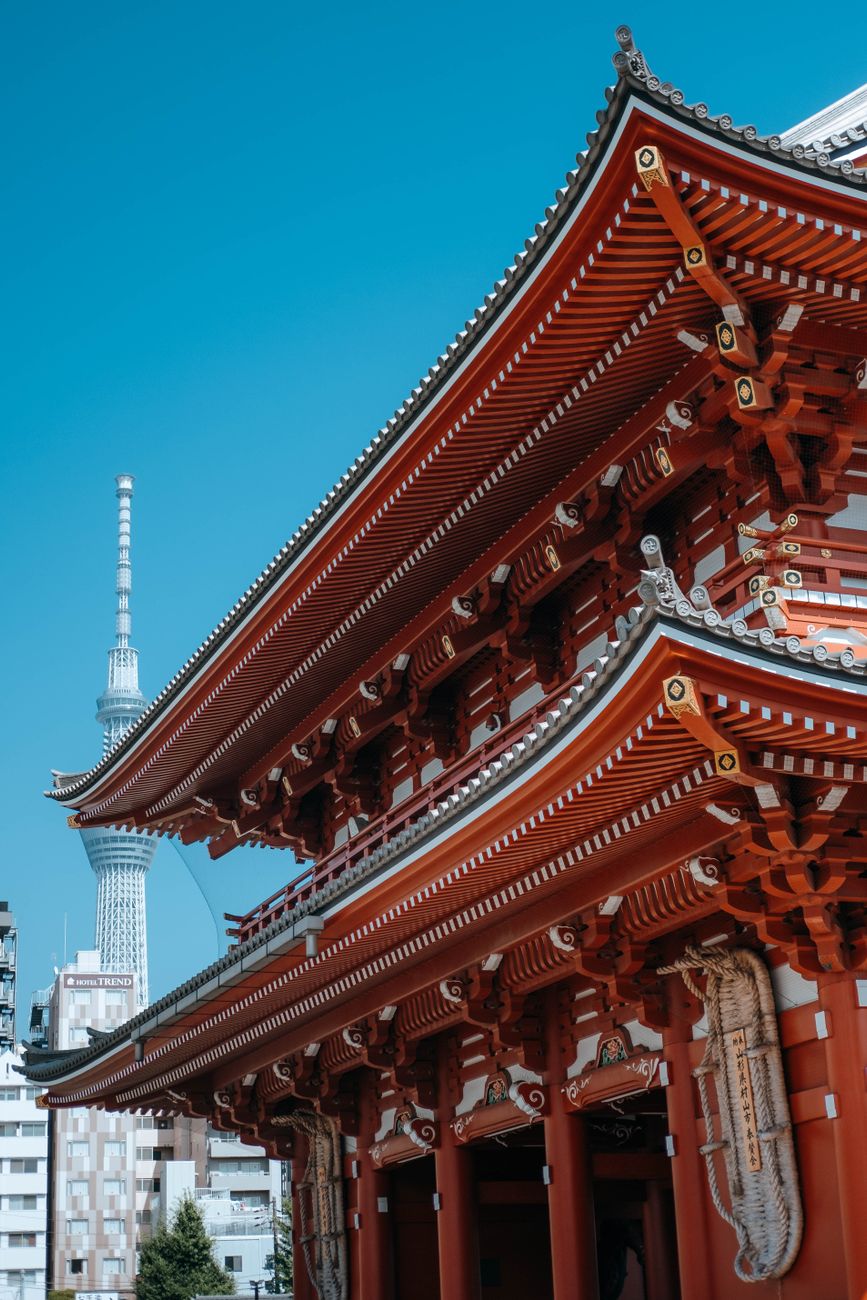
Most visitors assume the buildings at Senso-ji have stood since the Edo period. Most of them have not. The temple’s history genuinely reaches back to 628, and a real Edo-period Kaminarimon did once stand here — but the gate and main hall you photograph today are both twentieth-century reconstructions, for reasons worth knowing before you go.
Practical details
| Admission | Free |
| Hours | Main hall and amulet shops 6:00–17:00 (from 6:30 in winter). The temple grounds themselves are open 24 hours. |
| Getting there | 5 minutes on foot from Asakusa Station — Tokyo Metro Ginza Line, Toei Asakusa Line, Tobu Skytree Line, or Tsukuba Express. |
The founding story
By temple tradition, two fishermen brothers — Hinokuma no Hamanari and Hinokuma no Takenari — were casting nets in the Sumida River on 18 March 628 when they pulled up a small golden statue. A local landowner named Haji no Nakatomo recognised it as an image of Sho Kannon, the bodhisattva of compassion, and converted his own home into a place of worship for it. That is the origin of what became Tokyo’s oldest temple — nearly a thousand years before the Edo period began.
What is old, and what is not
Kaminarimon. The gate was first built in 942. Its last pre-war incarnation dates to 1649, rebuilt with the backing of the third Tokugawa shogun, Iemitsu — so a genuine Edo-period structure did stand on this spot. It burned down in 1865 and, unusually, was not replaced for ninety-five years. The gate you photograph today is a reinforced-concrete reconstruction completed in 1960, funded by Panasonic founder Konosuke Matsushita.
The main hall. The original was designated a National Treasure in 1907 and destroyed in the Tokyo air raid of 10 March 1945. The current hall is a reinforced-concrete reconstruction completed in 1958, built to reproduce the original roofline.
Nakamise-dori. This one is genuinely Edo-period in origin. Merchants were granted commercial rights along the approach in exchange for maintaining the temple grounds. The stalls standing today are modern buildings, but the arrangement itself — and the street’s role as the formal approach to the temple — goes back centuries.
Practical notes
- Arrive before 8am for photographs of Kaminarimon and Nakamise-dori without crowds. The grounds are open around the clock, but most Nakamise shops open between 9 and 10.
- Entry to the temple is free. Be wary of anyone at the gate offering paid “guided access”.
- Hiroshige depicted this temple in Kinryūzan Temple at Asakusa (1856), part of One Hundred Famous Views of Edo — worth looking up before you visit, to see how much of the sightline survives.
Common questions
Is the Kaminarimon gate original?
No. It is a 1960 concrete reconstruction. A genuine Edo-period gate stood on the site from 1649 until fire destroyed it in 1865, after which there was no gate at all for ninety-five years.
Is Senso-ji free?
Yes. Admission is free and the grounds are open 24 hours, though the main hall and amulet shops keep set hours.
Opening hours were checked against published temple information at the time of writing. Verify before travelling, as these can change.
 Edo Japan Guide
Leave a comment